Learning Content
The aim of this module is to help senior learners, adult educators and museum or gallery educators use interactive storytelling and guided discussions as practical educational techniques in cultural spaces.
The module supports participants in transforming a visit to a museum, gallery or community cultural space into an active learning experience. Instead of only looking at artworks or objects, participants learn how to ask questions, start conversations, build stories together and encourage different interpretations.
The module does not focus on formal art history or expert interpretation. Its main focus is on simple and accessible methods that help seniors participate, share ideas, listen to others and become more confident as future Cultural Ambassadors.
By the end of this module, learners will:
● understand the role of interactive storytelling in adult education and cultural learning;
● understand how storytelling and guided dialogue can help seniors become active participants during museum and gallery visits;
● learn how to transform observation of artworks, museum objects or exhibition themes into structured group discussions;
● explore narrative prompting techniques that help senior learners express ideas, associations and interpretations;
● learn how story circles and peer exchange support participation, listening and shared meaning-making;
● understand how to facilitate discussion-based learning without turning the activity into a formal lecture;
● learn how to design a simple storytelling-based activity plan for museums, galleries or community cultural spaces.
Knowledge and understanding
After completing this module, learners will be able to:
● explain what interactive storytelling means in adult education and cultural spaces;
● describe the difference between a formal lecture and a facilitated cultural discussion;
● identify the main elements of a simple story: place, character, situation, emotion, change and meaning;
● recognise the value of open-ended and narrative questions;
● understand how group storytelling supports dialogue, peer exchange and cultural participation;
● identify basic facilitation principles for keeping a discussion clear, respectful and connected to the cultural visit.
Practical skills
After completing this module, learners will be able to:
● use simple questions to help a group move from observation to dialogue;
● create narrative prompts inspired by artworks, museum objects, photographs or exhibition themes;
● guide a short story circle with senior participants;
● encourage participants to connect individual ideas into a shared group story;
● support balanced participation during a discussion;
● avoid giving long explanations when the aim is to facilitate dialogue;
● prepare a short storytelling-based activity plan.
Attitudes and confidence
After completing this module, learners are expected to feel more confident to:
● use storytelling as a simple and inclusive way to engage seniors in cultural activities;
● invite different interpretations without looking for only one “correct” answer;
● value seniors’ ideas, experiences and personal perspectives;
● support a friendly and participatory atmosphere;
● act as Cultural Ambassadors who encourage older adults to take part in cultural life.
Museums, galleries and cultural spaces are not only places where people look at objects or listen to explanations. They can also become places where people talk, imagine, ask questions and learn from each other.
For many seniors, a cultural visit becomes more meaningful when they are invited to participate actively. A painting, a photograph, an old object or even a room in a museum can open a conversation. It can help people share impressions, personal views, small stories or questions.
This module focuses on interactive storytelling and guided discussions as simple educational techniques. These methods do not require participants to be art experts. What matters is the ability to observe, listen, ask good questions and create a space where different interpretations can be shared.
This approach is connected to adult learning. Adults usually learn better when the activity is practical, relevant to their own experience and based on exchange rather than passive listening.
In museums and galleries, this means moving from “I will explain this artwork to you” to “Let us look at this together and see what meanings we can build.” This change is important for Senior Cultural Ambassadors. Their role is not to act as formal lecturers, but to encourage participation, support dialogue and help other older adults feel more connected to cultural life.
Through storytelling and discussion, seniors can become part of a participatory cultural experience, not only visitors standing in front of an exhibit.
In this module, learners will explore how to use narrative prompts, story circles and discussion-based techniques to turn cultural observation into active learning.
Interactive storytelling is not the same as simply telling a story to a group. In this module, it means using stories as a way to invite people into a conversation. The facilitator does not give all the answers. Instead, they help participants observe, imagine, ask questions, share ideas and build meaning together.
This is especially useful in adult education. Adults bring many life experiences with them and usually learn better when the activity feels relevant, respectful and connected to real situations.
In a museum or gallery, interactive storytelling can begin with something very simple: a painting, an object, a photograph, a room, a colour or a detail that someone notices first. The object becomes a starting point. It does not have to lead to one “correct” interpretation. It can open several possible meanings.
For Senior Cultural Ambassadors, this is important. They do not need to explain everything about the artist, the period or the style. Their role is to help other seniors feel invited into the cultural experience. A good question can sometimes do more than a long explanation.
Storytelling feels natural for many people. Seniors often have rich life experiences, opinions and personal associations. When they are invited to speak, they can connect what they see in a cultural space with something they know from life.
This does not mean that every activity must become a memory exercise. In this module, storytelling is used as an educational and facilitation technique. It helps people move from silent observation to active participation.
Instead of asking only:
“What is the title of this painting?”
the facilitator may ask:
“What do you think is happening here?”
“What could have happened before this moment?”
“If this object could speak, what would it say?”
These questions do not test knowledge. They open thinking.
Interactive storytelling supports learning in several ways.
First, it helps participants pay attention. When people know they will be invited to say something, they often look more carefully.
Second, it gives value to personal interpretation. Seniors may feel that they do not know “enough” to speak in a cultural space. Storytelling reduces this pressure.
Third, it encourages dialogue. One person’s idea can inspire another person’s idea. A group can slowly build a shared story, even if participants started from different points of view.
Finally, it supports confidence. A senior who speaks once in a small group may feel more ready to speak again.
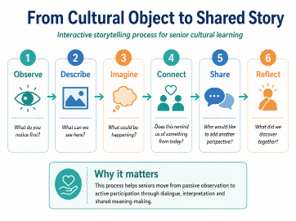
For this module, we can use six simple principles.
Before asking people to imagine or interpret, give them time to look.
Useful questions:
● What do you notice first?
● What details attract your attention?
● What is happening in this image or object?
Do not begin with difficult questions. Start with what people can see, then move to what they think, feel or imagine.
A simple path can be:
● What do we see?
● What do we think is happening?
● What story could be behind this?
● What does this make us think about today?
A narrative prompt is a question or sentence that helps people create a story. It does not give the answer. It opens a door.
Examples:
● Imagine this object had an owner. Who could that person be?
● What could be the first sentence of a story about this image?
● What might happen next?
● What title would you give to this moment?
In interactive storytelling, different answers are welcome. Two people may see the same image and imagine different stories. This is part of the learning process.
The facilitator can say:
● That is an interesting point of view. Does someone see it differently?
● Can we add another possibility?
● What other story could be here?
The discussion can become creative, but it should not become disconnected from the visit. The facilitator can gently bring the group back:Which detail in the painting made you think of that?
● Where do we see this idea in the object?
● What part of the exhibition connects with your story?
At the end, ask one final question that helps participants reflect.
Examples:
● What idea will you take with you you from this discussion?
● Did this object make you think differently about something?
● What did we discover together?
A group of seniors is visiting a gallery. They stop in front of a painting showing a street scene.
The facilitator does not begin with the artist’s biography. Instead, they say:
“Let us look at this scene for a moment. What do you notice first?”
One participant notices the people in the background. Another notices the light. Someone else sees an open window. The facilitator then asks:
“If this street had a story, what could be happening here?”
The group builds possible stories. Maybe someone is waiting for a letter. Maybe the street is preparing for a celebration. Maybe the open window belongs to someone watching quietly.
After a few minutes, the facilitator connects the story back to the artwork:
“Which details helped us imagine this story?”
This simple activity helps the group observe, speak freely and connect their ideas.
A cultural visit often starts with looking. People enter a museum or gallery, stop in front of an artwork or object, and try to understand what they see. Sometimes they wait for someone to explain it. Sometimes they stay silent because they feel they do not know enough.
Guided dialogue changes this situation. It helps participants move from simply looking at something to talking about it together.
The facilitator does not need to give a lecture. Instead, they guide the group with clear, simple questions. These questions help people notice details, explain their thoughts, listen to others and slowly build understanding.
Guided dialogue is a structured conversation. It is not a free discussion where people jump from one topic to another. It is also not a formal presentation where one person speaks and the others only listen.
The facilitator prepares a few questions and uses them to guide the group step by step. The conversation stays connected to the artwork, object or cultural space, but participants are invited to bring their own thoughts into the discussion.
Visual Thinking Strategies offers a useful example of this approach. VTS discussions use open questions that encourage people to look carefully, give reasons for their ideas and search for more details. For this module, we do not need to copy VTS exactly, but we can use its logic: start with observation, ask for evidence and invite more voices.
Many cultural discussions begin with factual questions:
● Who made this?
● When was it created?
● What style is it?
These questions can be useful, but they may also make participants feel tested. Guided dialogue starts from what people can see, think and wonder.
Instead of asking… | Try asking… |
Who painted this? | What do you notice first? |
What period is this from? | What details make you curious? |
What does this artwork mean? | What possible meanings can we find here? |
Is this object important? | Why might this object have mattered to someone? |
What is the correct interpretation? | What different interpretations can we build together? |
This small change makes the activity more accessible. Participants do not need specialised knowledge to begin.
The See, Think, Wonder routine follows a similar path: learners first say what they see, then what they think, and then what the object or image makes them wonder.
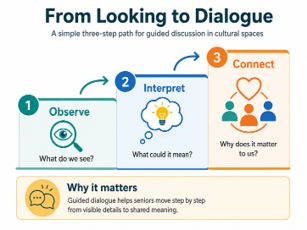
A simple guided dialogue can follow three steps.
1. Observation
This is the safest starting point. Ask participants to describe what is visible.
Useful questions:
● What do you see?
● What colours, shapes or people do you notice?
● Where does your eye go first?
● What small detail did you discover after looking longer?
At this stage, the facilitator should not correct answers too quickly. The goal is to help people look more carefully.
2. Interpretation
Now the group can move from seeing to thinking.
Useful questions:
● What do you think is happening here?
● What makes you say that?
● What mood or atmosphere do you feel?
● What could this object tell us about the person who used it?
The question “What makes you say that?” is especially useful because it asks participants to connect their idea with something visible.
3. Connection
Only after observation and interpretation should the facilitator invite broader links.
Useful questions:
● Does this remind us of something from everyday life?
● Can we connect this object with a local tradition, family story or community experience?
● What does this image make us think about today?
● Why could this still be meaningful for people now?
This step helps the group connect culture with life.
The facilitator keeps the conversation moving without controlling every answer.
A facilitator should:
● give people time to look before speaking;
● ask one question at a time;
● listen carefully and repeat key ideas in simple words;
● invite quieter participants without pressure;
● connect different answers when possible;
● bring the group back to the artwork or object if needed;
● avoid long explanations unless they are really needed.
For example, if one participant says, “This painting feels lonely,” the facilitator can respond:
“You noticed a feeling of loneliness. What details in the painting give you that impression?”
This values the participant’s idea, asks for a reason and brings the group back to observation.
When to add factual information
Guided dialogue does not mean that factual information is forbidden. Historical or artistic information can be useful, but timing matters.
If the facilitator gives too much information at the beginning, participants may become passive. A better option is to let the group observe and discuss first. After that, the facilitator can add a short piece of information.
For example:
“You noticed the clothes, the posture and the objects on the table. One detail that may help us is that this painting was created during…”
The information becomes a support, not a replacement for dialogue.
Senior Cultural Ambassadors can use this short model during a museum or gallery visit:
Choose one object or artwork.
Give 30–60 seconds of silent looking time.
Ask: “What do you notice first?”
Ask: “What do you think could be happening here?”
Ask: “What do you see that makes you think so?”
Ask: “Does someone have another idea?”
Ask: “What can this object tell us about people, community or life today?”
Close with: “What idea will you take with you from this discussion?”
This model is simple enough to be used by seniors, volunteers, adult educators or museum staff.
A Senior Cultural Ambassador is guiding a small group in a local gallery. The group stops in front of a portrait.
Instead of saying, “This is a portrait painted in a specific artistic style,” the ambassador starts with:
“Let us look quietly for a moment. What do you notice first?”
One person says the face looks serious. Another notices the hands. Someone else points to the dark background.
The ambassador continues:
“What do these details make you think about this person?”
The group gives different ideas. Some think the person looks tired. Others think the person looks proud. The ambassador asks:
“What do you see that makes you say that?”
Later, the ambassador adds a short factual detail, but only after the group has already explored the portrait.
The discussion ends with:
“If we had to describe this person in one word, what word would we choose?”
Not every group starts speaking easily. Some participants need time. Others need a clear question. Sometimes the difference between silence and conversation is one well-chosen prompt.
A narrative prompt is a short question, cue or unfinished idea that helps people begin a story, continue a thought or look at a cultural object from a new angle. It gives direction, but it does not control the answer.
For senior learners, this matters. A prompt can reduce pressure and make the task feel concrete.
A narrative prompt is not the same as a factual question.
A factual question usually asks for information:
● Who made this object?
● What year is this from?
● What is the title of the artwork?
A narrative prompt invites imagination, interpretation or connection:
● Who might have used this object?
● What could be happening in this scene?
● If this room could speak, what story would it tell?
● What happened just before this moment?
This kind of prompt supports participation because it does not test knowledge. It invites contribution.
Narrative prompts are helpful with adults aged 55+ for a few reasons.
First, they offer structure. Some seniors may hesitate at the beginning of a discussion. A good prompt gives them a place to start.
Second, prompts allow different entry points. One person may respond through observation. Another may respond through imagination. Someone else may connect the object with everyday life.
Third, prompts make the conversation feel human. Instead of asking for the “correct” interpretation, they invite curiosity and voice.
Finally, they support adult learning principles, because adults engage more when learning feels relevant, practical and connected to experience.
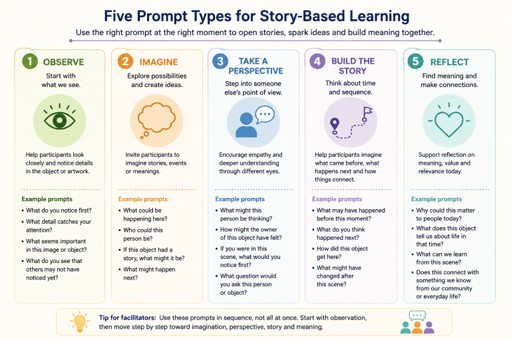
For this module, it is useful to work with five simple types.
1. Observation prompts
These prompts help participants begin with what is visible.
Examples:
● What do you notice first?
● What detail catches your attention?
● What seems important in this image?
● What do you see that others may not have noticed yet?
2. Imagination prompts
These prompts help participants create possible meanings or stories.
Examples:
● What could be happening here?
● Who could this person be?
● If this object had a story, what might it be?
● What might happen next?
3. Perspective prompts
These prompts help participants enter the story from a point of view.
Examples:
● What might this person be thinking?
● How might the owner of this object have felt?
● If you were standing in this scene, what would you notice first?
● What question would you ask this person or object?
4. Sequence prompts
These prompts help participants imagine time.
Examples:
● What may have happened before this moment?
● What do you think happened next?
● How did this object get here?
● What might have changed after this scene?
These questions are especially useful with paintings, photographs, historical objects and exhibition displays. They help participants build narrative flow, not just isolated impressions.
5. Meaning-making prompts
These prompts help the group reflect on significance.
Examples:
● Why could this matter to people today?
● What does this object tell us about life in that time?
● What can we learn from this scene?
● Does this connect with something we know from our community or everyday life?
A good prompt should be:
● clear;
● short;
● open-ended;
● linked to the object or artwork;
● easy to understand.
It should not sound like an exam question.
A very broad question, such as “What is the meaning of beauty?”, may be interesting but too abstract for the beginning of a cultural discussion.
A stronger prompt is more grounded:
● “What in this painting feels calm or unsettled?”
“What detail tells us something about this person’s life?”
“If this object could tell one short story, what would it say?”
Questions like these may be interesting, but they are too abstract for the beginning of a cultural discussion.
Prompts work best when they are used in a simple sequence. Three or four good questions are enough.
A useful sequence could be:
Start with observation: What do you notice first?
Move to interpretation: What do you think is happening here?
Invite perspective: What might this person or object be trying to tell us?
End with reflection: Why does this matter to us today?
This gradual structure helps quieter participants join in.
Senior learners are not one single group. Some are confident. Others need more time. Prompts should be adapted with care.
Practical tips:
● Use simple language.
● Ask one question at a time.
● Give people time to think.
● Repeat or rephrase the question if needed.
● Use follow-up prompts.
● Avoid prompts that feel too personal too soon.
The module is not built around therapy or personal disclosure. Participants may choose to share something personal, but the facilitator should not push them in that direction.
Examples:
● What do you see that makes you say that?
● Can someone add another possibility?
● Does anyone notice something different?
● Which detail helped you imagine that story?
● Can we connect these two ideas?
● What word would you use to describe this scene?
These smaller prompts are often just as important as the main one. They keep the conversation alive.
A small group of seniors is standing in front of an old black-and-white photograph in a local museum. The image shows several people gathered outside a building.
The facilitator begins with an observation prompt:
“What do you notice first in this photograph?”
One participant notices the clothing. Another notices the serious expressions. Someone else notices the building.
Then the facilitator moves to an imagination prompt:
“What do you think might be happening in this moment?”
The group suggests ideas: maybe it is a formal event, a family gathering or something connected to community life.
Next comes a perspective prompt:
“If one of these people could speak, what might they tell us?”
Finally, the facilitator closes with a meaning-making prompt:
“What might this photograph tell us about life in this community?”
The photograph is no longer just being viewed. It becomes a starting point for shared cultural conversation.
Try to avoid:
● questions with only one correct answer;
● very long questions;
● abstract questions at the beginning;
● prompts that move too far away from the object;
● too many prompts in a short time;
● interrupting participants too quickly.
A good discussion needs rhythm, not speed.
Some cultural activities need a slower rhythm. People need time to speak, listen, compare ideas and build something together.
A story circle can help with this.
In this module, a story circle means a simple group method where participants sit or stand together and take turns sharing short ideas, impressions or stories inspired by an artwork, object, photograph, exhibition theme or cultural space.
It is not a lecture. It is not a debate. It is a structured exchange where each person can add a voice.
The method is useful for Senior Cultural Ambassadors because it gives them a clear and friendly way to involve a group. They need to choose a good focus, explain the activity clearly, invite short contributions and help the group connect ideas.
A museum or gallery visit can sometimes feel one-directional. One person speaks, others listen. A story circle changes this dynamic and gives more space to the group.
For seniors, this can be especially valuable. Many older adults have rich life experience, but they may not always feel invited to speak in cultural institutions. A story circle sends a different message: your view matters here.
Story circles also support peer exchange. Participants do not learn only from the facilitator. They learn from each other.
A normal discussion can be useful, but it can also become unbalanced. Some people speak a lot. Others stay quiet. The topic can move too far from the cultural object.
A story circle has a clearer structure. Usually, it includes:
● one selected artwork, object or theme;
● one guiding question or prompt;
● short contributions from participants;
● active listening;
● a moment where ideas are connected;
● a closing reflection.
The structure gives enough freedom for personal expression, but enough guidance to keep the activity meaningful.
A simple story circle can follow five steps.
1. Choose a clear focus
Start with one object, artwork, photograph or exhibition theme. Do not choose too many things at once.
Good starting points can be:
● a portrait;
● a family object;
● a local heritage object;
● a photograph of community life;
● a painting with people or visible action;
● an object connected to work, home, celebration, travel or change.
2. Invite short individual contributions
Ask participants to share one short thought, image or story.
Examples:
● What is one word that comes to mind when you look at this object?
● What small story could begin here?
● What does this image make you think about?
The first answer does not need to be perfect. It only needs to open the circle.
3. Encourage listening, not only speaking
In a story circle, listening is as important as talking.
The facilitator can say:
“As you listen, try to notice one idea that connects with your own.”
This helps people listen for links, not only wait for their turn.
4. Link ideas together
After several people have shared, the facilitator helps the group connect ideas.
For example:
“I heard several ideas: waiting, family and change. Can we connect these into one possible story?”
or:
“We have two different views: one sees this scene as joyful, another as serious. What details support each view?”
This step helps the group build shared meaning.
5. Close with shared meaning
A story circle should not end suddenly. It needs a short closing moment.
Useful closing questions:
● What did we discover together?
● Which idea stayed with you?
● What sentence could summarise our group story?
● What question would we like to leave open?
Peer exchange means that participants learn with and from each other. Each person’s contribution can become a learning resource for the group.
In a museum or gallery, peer exchange can happen when:
● one person notices a detail that others missed;
● someone connects an artwork with local life;
● two participants offer different interpretations;
● the group builds a story from several small contributions;
● participants ask each other questions.
This kind of exchange supports confidence and respects adult learners’ experience.
A story circle needs balance. If one or two people speak all the time, others may withdraw. If the facilitator speaks too much, the circle becomes a lecture.
A Senior Cultural Ambassador can use a few simple rules:
● explain that everyone is invited, but no one is forced;
● ask for short contributions in the first round;
● thank each speaker briefly;
● invite quieter participants gently;
● avoid correcting personal interpretations too quickly;
● bring the discussion back to the artwork or object when needed;
● close with one shared reflection.
Useful phrases:
“Let us hear one idea from each person who would like to speak.”
“Who can connect their idea with something already said?”
Story circles work well when the aim is participation, exchange and shared meaning.
They are useful:
● at the beginning of a visit, to warm up the group;
● in front of one powerful artwork or object;
● after a guided tour, to reflect on what stayed with people;
● in community galleries, where participants may have local knowledge;
● with intergenerational groups;
● in small senior groups where conversation is part of the learning goal.
For senior learners, a group of 6–10 participants is often easier to manage. Larger groups can be divided into smaller circles.
A group of eight seniors visits a gallery exhibition about local life. The Senior Cultural Ambassador chooses one old photograph showing people gathered in a public square.
The ambassador says:
“We will make a short story circle. Please look at the photograph for a moment. Then, each person who wants to speak can share one short idea: what kind of story could begin here?”
One participant mentions a market day. Another thinks it might be a celebration. Someone else notices the faces and says the people look worried.
The ambassador connects the ideas:
“We have market, celebration, worry and community meeting. What kind of day could include all these things?”
The group builds a shared story. At the end, the ambassador asks:
“What title would we give to the story we created together?”
The activity ends with a short reflection:
“What did this photograph help us understand about community life?”
A good story circle does not need to be perfect. It needs a clear focus, a simple prompt and enough time for people to listen to each other. The facilitator’s task is not to control the story. It is to help the story grow from the group.
In many museums and galleries, visitors are used to listening. A guide explains the artwork, gives historical details, presents the artist, and the group follows. This can be useful, especially when people want information.
However, the role of a Senior Cultural Ambassador is different. A Cultural Ambassador does not need to act like an art historian or museum expert. Their role is to help people take part in the cultural experience by asking questions, encouraging observation, inviting different points of view and helping the group build meaning together.
Discussion-based learning does not remove knowledge. It changes the way knowledge is introduced. Instead of starting with a long explanation, the facilitator starts with the participants: what they see, think and wonder.
A lecturer usually speaks from expertise. A facilitator works with the group.
This does not mean that the facilitator knows nothing. It means that they use knowledge differently. They do not give all the information at once. They create space for the group to think first.
A formal lecture may begin like this:
“This painting was created in the second half of the nineteenth century and belongs to…”
A facilitated discussion may begin like this:
“Let us look at this painting for a moment. What do you notice first?”
The second option invites participation immediately. People are not asked to prove knowledge. They are invited to look.
Discussion-based learning is not a random conversation. It still needs structure. The facilitator guides the process, but the group contributes to the content.
A useful distinction is:
Formal art lecturing | Discussion-based learning |
The expert gives information. | The facilitator opens a conversation. |
Participants mostly listen. | Participants observe, speak and listen. |
The focus is often on facts and context. | The focus is on observation, interpretation and meaning. |
The “correct” answer may feel important. | Several interpretations can be explored. |
Information comes at the beginning. | Information is added when it helps the discussion. |
Both approaches can be useful. The problem appears when a cultural activity leaves no space for participants to think, react or contribute.
A simple method for Senior Cultural Ambassadors is:
1. Ask
Start with one open and accessible question.
Examples:
● What do you notice first?
● What detail attracts your attention?
● What do you think is happening here?
2. Listen
After asking the question, give people time. Do not answer for them too quickly.
Listening is active. The facilitator listens for key words, repeated ideas, emotions, differences and possible connections.
3. Link
Help participants see how their answers relate to each other.
Useful phrases:
● You both noticed something about atmosphere. Can we compare these ideas?
● One person saw this as joyful, another as serious. What details support each interpretation?
● Can we connect this idea with what was said earlier?
4. Add
Add a short piece of information only when it supports the discussion.
Example:
“This object was often used in family households. Knowing this, does it change how we see it?”
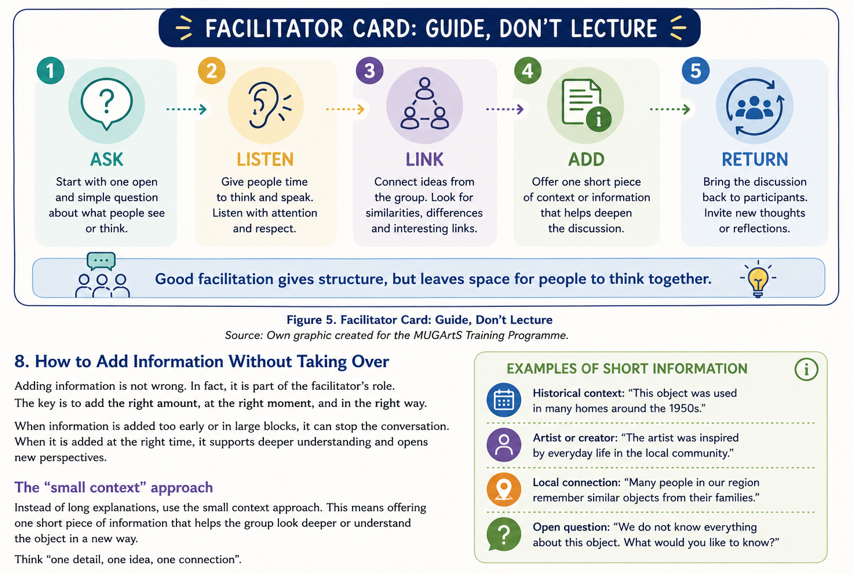
5. Return
After adding information, return to the participants.
Examples:
● Now that we know this, what do you notice differently?
● Does this information change your interpretation?
● What new question do we have?
This is what keeps the activity from becoming a lecture.
Information is important, but timing matters.
A better approach is:
first, allow people to observe;
then, invite interpretation;
after that, add one short piece of context;
finally, ask the group to respond again.
For example, in front of an old photograph, the facilitator might first ask:
“What kind of moment do you think this photograph shows?”
After the group discusses, the facilitator can add:
“This photograph was taken during a community event in the 1960s.”
Then they return to the group:
“Knowing this, what details become more interesting?”
To start
● Let us take a moment to look before we speak.
● What do you notice first?
● There is no need for a correct answer. We can start from what we see.
To continue
● What makes you say that?
● Can someone add another idea?
● Does anyone see it differently?
● Which detail helped you think of that?
To connect ideas
● I hear two interesting directions here.
● Can we connect these ideas?
● What do these answers have in common?
To add information
● I will add one small detail that may help us.
● One useful piece of context is…
● Let us see if this changes our interpretation.
To close
● What idea will you take with you?
● What did we discover together?
● What question remains open?
Try to avoid:
● long explanations at the beginning;
● questions with only one correct answer;
● correcting participants too quickly;
● using too many specialised terms;
● asking several questions at the same time;
● letting one participant dominate;
● forgetting to return to the object or artwork.
A Senior Cultural Ambassador is guiding a small group through a local gallery. They stop in front of a painting showing rural life.
A lecture-style beginning could be:
“This painting represents rural life and belongs to a tradition of realistic representation.”
A discussion-based beginning could be:
“Let us look at this painting for a moment. What do you notice first?”
One participant mentions the people. Another notices the colours. Someone else says the scene looks tiring, but peaceful.
The ambassador links the answers:
“We have two ideas here: hard work and calm atmosphere. What details show each of them?”
Only after this, the ambassador adds a short piece of context:
“Many artworks showing rural life also tell us something about community, work and daily routines.”
Then the ambassador returns to the group:
“Does this help us see the painting differently?”
The group is still learning, but they are learning through participation.
Senior Cultural Ambassadors are not expected to replace professional guides. Their strength is different. They can help other seniors feel welcome, heard and involved.
When they facilitate discussion instead of giving a lecture, the cultural visit becomes more than an information session. It becomes a shared learning moment.
A good storytelling activity does not happen by accident. It may feel natural during the visit, but behind it there is usually a simple plan.
For Senior Cultural Ambassadors, planning gives confidence. When the ambassador knows the aim, the chosen object, the main questions and the closing moment, it becomes easier to guide the group.
The plan does not need to be long. It only needs to be clear.
A simple plan helps the facilitator:
● keep the activity focused;
● avoid speaking too much;
● choose questions that are easy to follow;
● include more participants;
● manage time better;
● connect the discussion with the cultural space;
● close the activity with a clear idea.
Planning also makes the activity easier to repeat and adapt.
Before choosing questions, the Cultural Ambassador should ask:
What do I want this activity to help participants do?
The aim should be simple. For example:
● to help participants observe one artwork more carefully;
● to encourage seniors to share different interpretations;
● to connect an object with local life or community experience;
● to create a short group story inspired by an image;
● to reflect on how cultural spaces can speak to people today.
Instead of planning “a discussion about art,” it is better to plan:
“A 30-minute storytelling activity where seniors create a shared story inspired by one photograph.”
A storytelling activity works best when it has a clear starting point. One object or artwork is often enough.
Good options include:
● a portrait;
● a photograph;
● a local heritage object;
● a household item;
● a painting with people, movement or emotion;
● a room or corner of a museum;
● a theme from an exhibition.
The chosen focus should be visible, accessible and open to interpretation.
A Senior Cultural Ambassador should also think about the group.
Useful questions:
● How many participants will be there?
● Do they already know each other?
● Are they comfortable speaking in a group?
● Do they need more time to move through the space?
● Do they prefer sitting or standing?
● Will everyone be able to see and hear well?
For seniors, comfort matters. If people are tired, cannot hear well or cannot see the object clearly, the discussion will suffer.
A question pathway is a short sequence of questions that helps the discussion move step by step.
Example:
Observation: What do you notice first?
Interpretation: What do you think could be happening here?
Story: If this object could tell a story, what would it say?
Connection: Does this remind us of everyday life or community life?
Closing: What idea will you take with you from this activity?
Three to five good questions are enough.
A storytelling activity needs rhythm. It cannot be only questions. It also needs silence, listening and short transitions.
A simple rhythm could be:
Welcome and explain the activity – 2 minutes
Silent observation – 1 minute
First question: what do we notice? – 5 minutes
Story-building prompt – 10 minutes
Group sharing or story circle – 10 minutes
Short context added by facilitator – 3 minutes
Final reflection – 5 minutes
The facilitator can adapt this rhythm according to the group.
The activity plan can include one or two pieces of information about the artwork or object.
Useful information can be:
● the period when the object was created;
● who used the object;
● a local connection;
● a detail about the artist;
● a cultural tradition connected to the object.
The facilitator should avoid long explanations. A useful rule is:
one object, one main aim, one short context, one closing reflection.
Many activities start well but end suddenly. A closing moment helps participants understand what they have created or discovered.
Good closing questions:
● What did we discover together?
● What surprised you?
● Which idea stayed with you?
● What title would you give to our group story?
● What question would you like to keep thinking about?
Senior Cultural Ambassadors can use this template before a visit:
Planning element | Questions to answer |
Activity title | What is the name of the activity? |
Aim | What should participants experience or practise? |
Cultural focus | Which artwork, object, photo or theme will we use? |
Participants | Who is the activity for? How many people? |
Duration | How much time do we have? |
Materials | What do we need? |
Question pathway | What 3–5 questions will guide the discussion? |
Short context | What one piece of information will we add? |
Closing | How will we end the activity? |
Adaptations | What do seniors need in order to participate comfortably? |
This table can also be turned into a worksheet.
Aim: To help seniors create a short story inspired by one cultural object.
Cultural focus: An old household object displayed in a museum.
Participants: 8 seniors.
Duration: 35 minutes.
Materials: Chairs, printed questions, paper and pen.
Question pathway:
What do you notice first about this object?
Who might have used it?
If this object could speak, what would it tell us?
What part of this story connects with life today?
What title would we give to our shared story?
Short context:
The facilitator adds one short detail about the object’s use in everyday life.
Closing:
The group chooses a title for the shared story and each participant says one word that describes the experience.
No plan should be used exactly the same way with every group. The facilitator should adapt it to the people, space and time available.
For a group that speaks easily, the facilitator can use more open questions.
For a quieter group, the facilitator can begin with one-word answers or pair discussion.
For people who get tired quickly, the activity should be shorter and include seating.
For larger groups, the facilitator can divide participants into small groups.
The best activity plan is not the most complicated one. It is the one that helps real people take part.
Do not try to plan everything perfectly. Prepare the aim, the object, the main questions and the closing moment. Then listen to the group. Often, the best part of the activity will come from something participants say.
Case study 1: Galeria de Artă „Zamca” – A Community Gallery Where Senior Artists and Local Stories Meet |
Country, city:: Romania, Suceava |
Practice holder/s: Galeria de Artă „Zamca”, Asociația Institutul pentru Parteneriat Social Bucovina |
Galeria de Artă „Zamca” in Suceava is a local cultural space that presents works by local, national and international artists. It functions not only as an exhibition space, but also as a place where community members can meet, discuss art and connect with local cultural identity.
A special feature of the gallery is its strong connection with senior artists and active ageing through culture. The curator of the gallery is the well-known graphic artist and caricaturist Mihai Pânzaru PIM, who is 80 years old and contributes voluntarily to the cultural life of the gallery.
Another meaningful example is maestrul Dimitrie Balint, one of the oldest artists exhibited at the gallery. He presents works annually, and this year he turns 96. His continued artistic presence shows that creativity and cultural participation can remain active throughout later life.. A photograph, a graphic artwork, a portrait or a local scene can become the starting point for guided dialogue: What do we notice? What story is hidden here? What does this image tell us about the community?
Source: Local information provided by Bucovina Institute and public information about Galeria de Artă „Zamca” exhibitions.
Case study 2: Galeria de Artă „Casa Zamfirescu” – Local Art in a Historic Community Space |
Country, city: Romania, Botoșani |
Practice holder/s: Galeria de Artă „Casa Zamfirescu” Location: Pietonalul Unirii, Botoșani |
Galeria de Artă „Casa Zamfirescu” is a cultural space in Botoșani, located on Pietonalul Unirii. The gallery was created in the historic Casa Zamfirescu building, which is more than 130 years old and was built in 1890. The building itself has cultural value due to its architecture, decorative details and history.
According to local information, the gallery exhibits works by local artists, including older artists. The building itself can also open a story: Who lived here? What has changed in the city? How do old buildings keep community memory? The artworks can also be used for storytelling-based activities, especially when they are connected to local life, landscapes, portraits or personal artistic expression.
Source: Public information about Galeria de Artă „Casa Zamfirescu” and local information provided for the MUGArtS module.
Case study 3: Age Friendly Museums Network – Making Museums More Open to Older People |
Country, city: United Kingdom, national network with local museum practices |
Practice holder/s:Age Friendly Museums Network / Culture, Health & Wellbeing Alliance Website: https://www.culturehealthandwellbeing.org.uk/age-friendly-museums-network |
The Age Friendly Museums Network is an example of how museums can become more welcoming and meaningful for older adults. The network brings together museum organisations that believe older people and museums enrich each other.
One relevant practice is the use of outreach activities and non-traditional ways for older people to interact with museum collections. For example, some activities bring museum objects or stories into community settings, making cultural participation easier for seniors who may face mobility, transport or confidence barriers.
For Senior Cultural Ambassadors, this example is useful because it shows that storytelling and discussion do not have to happen only inside a museum building. Cultural objects, photographs or reproductions can travel to the community and open conversations there.
Relevance for the module:
The example supports the idea that cultural learning can be flexible, accessible and based on dialogue with older adults. Source: Age Friendly Museums Network / Culture, Health & Wellbeing Alliance.
Case study 4: PLAY Project – Empowering Senior Citizens Through Digital Storytelling |
Country, city: Portugal, Italy and France / European project context |
Practice holder/s: PLAY Erasmus+ project Source platform: EPALE – Electronic Platform for Adult Learning in Europe |
The PLAY Erasmus+ project is an example of how storytelling can empower older adults and give them a platform to share their experiences, interests and perspectives. The project used digital storytelling as a way to support intercultural learning, European identity and social inclusion.
Although PLAY is not limited to museums or galleries, it is relevant for this module because it shows the educational value of storytelling with senior learners. It treats seniors as people with knowledge, creativity and voice.
The practice can inspire MUGArtS activities in cultural spaces. After a gallery visit, seniors could create short written, audio or photo-based stories inspired by one artwork, object or exhibition theme.
Relevance for the module:
The example shows how storytelling can continue after the visit and become part of a wider cultural participation process.
Source: EPALE article on the PLAY Erasmus+ project and digital storytelling with senior citizens.
Activity 1: The Object That Opens a Story |
Learning Objectives: To help participants use one artwork, museum object, photograph or cultural item as a starting point for interactive storytelling and guided discussion. |
Learning Outcomes: By the end of the activity, participants will be able to: ● observe a cultural object carefully; ● use simple narrative prompts to start a story; ● encourage different interpretations from participants; ● connect individual ideas into a short shared story. |
Duration: 40–45 minutes |
Type (individual or group):Group activity, 6–12 participants |
Needed equipment and materials: ● one artwork, museum object, photograph or reproduction; ● chairs arranged in a semi-circle or circle; ● flipchart / large paper; ● markers; ● optional: printed prompt cards. |
Step-by-step description: Stage 1: The facilitator chooses one cultural object, artwork or photograph that can open a conversation. It should have visible details and enough space for interpretation. Good examples include a portrait, an old photograph, a household object, a painting with people, or an item connected to local heritage. The facilitator prepares 4–5 simple prompts, such as: ● What do you notice first? ● What could be happening here? ● Who might have used this object? ● What might have happened before this moment? ● If this object could tell a story, what would it say? This activity is connected to the module content on interactive storytelling, narrative prompts and guided dialogue. Stage 2: Implementation ● Step 1: Invite participants to look silently at the selected object, artwork or photograph for one minute. ● Step 2: Ask a simple observation question: ● Step 3: Write down several key words mentioned by participants. ● Step 4: Move to a narrative prompt: ● Step 5: Invite participants to add short ideas. They do not need to agree. Different ideas are welcome. ● Step 6: Help the group connect the ideas. For example: ● Step 7: Together, create a short group story of 5–7 sentences. The facilitator can write it down while participants contribute. ● Step 8: Read the story aloud to the group. Stage 3: Feedback collection Ask participants: ● How did the object help us create a story? ● Was it easy or difficult to add ideas? ● What helped you feel involved? ● Could this method be used with other seniors in a museum or gallery? |
Tips and adaptationsThe aim is not to create a perfect literary text. The aim is to help participants observe, speak, listen and build meaning together. For shy participants, allow them to contribute one word or one short idea. For larger groups, divide participants into smaller groups. |
Activity 2: Prompt Cards for Cultural Dialogue |
Learning Objectives: To practise using different types of narrative prompts that encourage seniors to observe, imagine, take perspectives and reflect during a cultural visit. |
Learning Outcomes: By the end of the activity, participants will be able to: ● distinguish between factual questions and narrative prompts; ● choose suitable prompts for a cultural discussion; ● use prompts in a logical sequence; ● support discussion without turning the activity into a formal lecture. |
Duration: 35–40 minutes |
Type (individual or group): Small group activity, 4–8 participants per group |
Needed equipment and materials: ● printed prompt cards; ● one artwork, object or photograph per group; ● paper and pens; ● optional: coloured cards for different prompt types. |
Step-by-step description: Stage 1: Preparation The facilitator prepares five types of prompt cards: Observation prompts ● What do you notice first? ● What detail catches your attention? Imagination prompts ● What could be happening here? ● If this object had a story, what might it be? Perspective prompts ● What might this person be thinking? ● What would you ask this person or object? Story-building prompts ● What may have happened before this moment? ● What might happen next? Reflection prompts ● Why could this matter to people today? ● What can we learn from this object or image? The facilitator also selects one artwork, object or photograph for each group. This activity is connected to the module content on narrative prompting techniques and discussion-based learning. Stage 2: Implementation Step 1: Divide participants into small groups. Step 2: Give each group one artwork, object or photograph and a set of prompt cards. Step 3: Ask each group to choose three cards: ● one observation prompt; ● one imagination or story-building prompt; ● one reflection prompt. Step 4: Each group uses the selected prompts to create a short discussion around the image or object. Step 5: One person from each group shares: ● which prompts they selected; ● which prompt worked best; ● what kind of discussion it opened. Step 6: The facilitator briefly highlights that good prompts should be short, clear, open-ended and connected to the cultural object. Stage 3: Feedback collection Ask participants: ● Which prompt was easiest to answer? ● Which prompt created the most discussion? ● Were any prompts too difficult or too abstract? ● What kind of prompt would you use with a senior group? |
Tips and adaptations: Do not use too many prompts at once. Three good questions are usually enough. For senior participants, print the prompt cards in large font. Use simple words. Avoid abstract questions at the beginning. Start with what people can see, then move slowly toward imagination and reflection. If the group is less confident, the facilitator can first model one example before asking participants to work in small groups. |
Activity 3: Story Circle in the Gallery |
Learning Objectives: To practise a simple story circle method that supports peer exchange, active listening and shared meaning-making in a museum, gallery or community cultural space. |
Learning Outcomes: By the end of the activity, participants will be able to: ● organise a short story circle around one cultural object or theme; ● invite participants to share ideas one by one; ● listen and connect different contributions; ● close a group discussion with a shared reflection. |
Duration: 50–60 minutes |
Type (individual or group): Group activity, 6–10 participants |
Needed equipment and materials: ● one selected artwork, photograph, object or exhibition theme; ● chairs arranged in a circle, if possible; ● paper or worksheet; ● pens; ● optional: story circle worksheet. |
Step-by-step description: Stage 1: Preparation The facilitator chooses one cultural focus. It can be: ● a painting; ● a photograph; ● an old object; ● a local heritage item; ● a theme from an exhibition; ● a detail from the museum or gallery space. The facilitator prepares one central prompt, for example: “What kind of story could begin from this object?” or “What does this image tell us about people, community or daily life?” This activity is connected to the module content on story circles, peer exchange and facilitated cultural dialogue. Stage 2: Implementation ● Step 1: Invite participants to sit or stand in a circle. ● Step 2: Present the object, artwork or photograph and give everyone a short moment to look. ● Step 3: Explain the rule: each person who wants to speak can share one short idea, image, word or story. No one is forced to speak. ● Step 4: Ask the central prompt. ● Step 5: Let participants share in turn. The facilitator listens and notes key words. ● Step 6: After the first round, the facilitator connects ideas. For example: ● Step 7: Invite the group to build a short shared story or shared interpretation. ● Step 8: Close with one reflection question: Stage 3: Feedback collection Ask participants: ● Did the circle help everyone participate? ● What was easier: speaking, listening or connecting ideas? ● What did you learn from other people’s interpretations? ● How could this method be used during a cultural visit with seniors? |
Tips and adaptationsThe facilitator should not correct every interpretation. Their role is to guide, connect and keep the discussion respectful. For seniors who need more time, allow silence. For larger groups, create two smaller story circles. |
Interactive storytelling and guided discussions can help museums, galleries and cultural spaces become more open, personal and participatory for seniors. Through this module, learners explored how a cultural visit can move beyond passive observation and become a shared learning experience.
The role of a Senior Cultural Ambassador is not to provide formal lectures or expert interpretations. Instead, the ambassador can support the group by asking simple questions, inviting stories, connecting ideas and encouraging participants to look, think and speak together.
A painting, a photograph, an object or even a detail from a cultural space can become the beginning of a meaningful conversation. With the right prompts and a clear structure, seniors can share interpretations, listen to each other and build common meaning.
This module also showed that facilitation does not need to be complicated. A good activity can start with one object, one open question and enough time for people to respond. What matters most is the way the facilitator creates space for participation, respects different viewpoints and keeps the discussion connected to the cultural experience.
For future Cultural Ambassadors, these techniques can be used in museums, galleries, community centres or local cultural spaces. They can help seniors feel more confident, more involved and more connected to cultural life.
Main learning points
● Interactive storytelling is an educational technique, not only a creative exercise. It helps seniors observe, imagine, share and learn together.
● Guided dialogue helps participants move step by step from what they see, to what they think, and then to what the object or artwork may mean to them.
● Narrative prompts are useful tools for starting conversations. Good prompts are short, clear, open-ended and connected to the cultural object.
● Story circles support peer exchange, active listening and shared meaning-making in museums, galleries and community cultural spaces.
● A facilitator is not a formal lecturer. Their role is to ask, listen, link ideas, add short context when needed, and return the discussion to the group.
● A good storytelling activity needs a simple plan, including a clear aim, one cultural focus, a few guiding questions, short information and a closing reflection.
Cultural Ambassador – A senior who supports cultural participation in their community. A Cultural Ambassador helps other people feel welcome in museums, galleries and cultural spaces by encouraging dialogue, curiosity and shared learning.
Interactive storytelling – A storytelling method where participants do not only listen to a story, but also help create it. They share ideas, answer prompts and build meaning together.
Guided dialogue – A structured conversation led by a facilitator. The facilitator uses simple questions to help participants observe, think, speak and listen to each other.
Narrative prompt – A short question or sentence that helps people start or continue a story. For example: “What could be happening here?” or “If this object could speak, what would it say?”
Open-ended question – A question that can have more than one answer. It invites people to share ideas, impressions or interpretations, instead of looking for one correct response.
Story circle – A group activity where participants take turns sharing short ideas, impressions or stories around one artwork, object, photograph or cultural theme.
Peer exchange – A learning process where participants learn from each other. In this module, peer exchange happens when seniors listen, respond and build on each other’s ideas.
Discussion-based learning – A learning approach based on conversation and participation. Participants learn by observing, asking questions, sharing opinions and reflecting together.
Facilitator – A person who guides a group activity. The facilitator does not give all the answers, but helps people participate, listen and connect ideas.
Formal lecture – A teaching method where one person gives information while the others mostly listen. In this module, formal lecturing is different from facilitation, which is more participatory.
Observation – The act of looking carefully at an artwork, object, photograph or cultural space and noticing details before interpreting it.
Interpretation – The meaning or explanation that a person gives to something they see. Different people can have different interpretations of the same artwork or object.
Meaning-making – The process of creating personal or shared understanding. In cultural spaces, meaning-making happens when people connect what they see with ideas, experiences or questions.
Storytelling-based activity – A planned activity where a cultural object, artwork or photograph is used as a starting point for stories, dialogue and reflection.
Question pathway – A short sequence of questions that guides a discussion step by step, usually from observation to interpretation, storytelling and reflection.
This section includes the main sources used in the module and additional resources useful for Senior Cultural Ambassadors, adult educators and museum/gallery educators. Most resources are in English and can be translated with free online translation tools.
A. Bibliography and sources used in the module
1. International Council of Museums – Museum Definition
Language: English
Type of resource: Official institutional resource
Why it was used: This resource supports the idea that museums are accessible and inclusive spaces that offer experiences for education, reflection, knowledge sharing and community participation.
Link: https://icom.museum/en/resources/standards-guidelines/museum-definition/
2. Visual Thinking Strategies – VTS Institute
Language: English
Type of resource: Museum education method
Why it was used: VTS supports open-ended, art-based discussions that strengthen observation, communication and collaboration.
Link: https://vtshome.org/about/
3. Project Zero – See, Think, Wonder
Language: English
Type of resource: Thinking routine / educational method
Why it was used: This routine helps learners move from observation to interpretation and curiosity.
Link: https://pz.harvard.edu/resources/see-think-wonder
4. Project Zero, Harvard Graduate School of Education – What Makes You Say That?
Language: English
Type of resource: Thinking routine
Why it was used: It encourages participants to explain their interpretations using visible evidence.
Link: https://pz.harvard.edu/resources/what-makes-you-say
5. Project Zero – Circle of Viewpoints
Language: English
Type of resource: Perspective-taking routine
Why it was used: It supports story circles and peer exchange by encouraging different perspectives.
Link: https://pz.harvard.edu/resources/circle-of-viewpoints
6. UNESCO – Manual for Developing Intercultural Competencies: Story Circles
Language: English
Type of resource: Manual / educational methodology
Why it was used: It presents Story Circles as a structured but flexible method for dialogue and intercultural learning.
Link: https://unesdoc.unesco.org/ark:/48223/pf0000370336.locale=en
7. MoMA – Teaching Resources
Language: English
Type of resource: Museum education resources
Why it was used: MoMA provides resources that encourage close looking, discussion and critical thinking through artworks.
Link: https://www.moma.org/teaching/
8. EPALE – Storytelling to Improve Adult Education
Language: English
Type of resource: Adult education article
Why it was used: It supports the use of storytelling as a method in adult education.
Link: https://epale.ec.europa.eu/en/resource-centre/content/storytelling-improve-adult-education
9. StoryComp – Storytelling Competences for Adult Education
Language: English
Type of resource: Erasmus+ project resource
Why it was used: It provides practical resources for using storytelling in adult learning.
Link: https://storycomp.eu/
10. Knowles, M. S., Holton, E. F., & Swanson, R. A. – The Adult Learner
Language: English
Type of resource: Book / adult learning theory
Why it was used: It is a key reference for adult learning principles.
Suggested citation: Knowles, M. S., Holton, E. F., & Swanson, R. A. The Adult Learner: The Definitive Classic in Adult Education and Human Resource Development.
1. Project Zero – Thinking Routines Toolbox
Language: English
Type of resource: Collection of practical thinking routines
Why it is useful: It is a key reference for adult learning principles.
Link: https://pz.harvard.edu/thinking-routines
2. The Metropolitan Museum of Art – Lesson Plans
Language: English
Type of resource: Museum education activity examples
Why it is useful: The lesson structures can inspire adapted activities for adult and senior learners.
Link: https://www.metmuseum.org/learn/educators/lesson-plans
3. MoMA – Weekly Lessons
Language: English
Type of resource: Short art-based learning activities
Why it is useful: These short lessons can inspire simple cultural learning exercises with seniors.
Link: https://www.moma.org/research-and-learning/teachers/weekly-lessons
4. StoryComp – Resources
Language: English
Type of resource: Practical storytelling resources for adult education
Why it is useful: It provides tools and materials for educators who want to use storytelling in adult learning.
Link: https://storycomp.eu/resources/
5. UNESCO Digital Library
Language: Multiple languages
Type of resource: Open-access digital library
Why it is useful: It offers trusted resources on culture, education, intercultural dialogue and lifelong learning.
Link: https://unesdoc.unesco.org/
6. Smithsonian Learning Lab – Project Zero Thinking Routines Collection
Language: English
Type of resource: Online collection / educational routines
Why it is useful: It presents thinking routines in an accessible format.
Link: https://learninglab.si.edu/collections/project-zero-thinking-routines/oWYbEjpf19oxcFUp
7. Yale University Art Gallery – Visual Thinking Strategies Open Educational Resources
Language: English
Type of resource: Open educational resource / visual discussion method
Why it is useful: It presents thinking routines in an accessible format.
Link: https://artlang.yale.edu/visual-thinking-strategies-vts
If learners want to start with only a few resources, the most practical ones are:
See, Think, Wonder – for simple guided observation.
Visual Thinking Strategies – for open-ended art discussion.
UNESCO Story Circles – for structured group storytelling.
StoryComp Resources – for storytelling in adult education.
Project Zero Thinking Routines Toolbox – for ready-to-use discussion routines.